

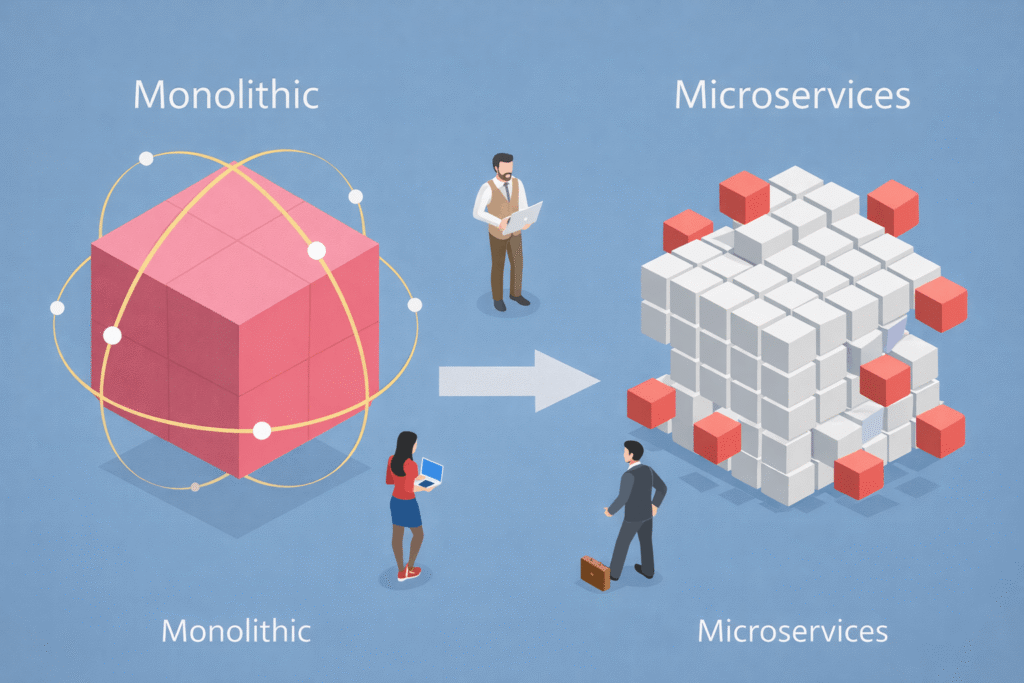
Although the debate between monolithic and micro services architecture has been around for a while, it is still an issue that is relevant in the current era. The question of whether one should begin with a monolith and scale to micro services later or design for micro services from the very start remains a problem for new teams.
If you can’t design a well-structured monolith, why would you believe you can build a well structured set of micro services? “Micro services do not fix bad code; they simply distribute it,” says Simon Brown, an architectural consultant.
The problem with this debate is that it is normally presented as a zero sum game. The truth is that architecture is all about tradeoffs and not trophies. The only choices that are available to you are those that fit or do not fit your team, product, and stage of growth, and there is no magic bullet.
This blog will discuss the differences between monoliths and micro services in a decision driven and pragmatic manner. Rather than espousing philosophy, we will instead provide coaching on how to assist beginners, seasoned engineers, and new startups.

A Monolithic Architecture: What Is It?
A monolithic architecture is a single, cohesive program in which the business logic, data access, and user interface are all created, implemented, and scaled jointly. Everything functions as a single process and resides in a single codebase.
This translates to simplicity in real life. Developers use a single runtime for system debugging, collaborate in a single repository, and share common models and libraries. Because there is just one environment to maintain and one item to send, deployments are simple.
The Significance of Monoliths
Monoliths work particularly well when development speed is more important than long term scalability. The lower operational overhead frequently results in quicker iterations and fewer manufacturing problems for small teams or early stage projects. Infrastructure costs remain minimal, performance is predictable, and testing is easier.
Where Monoliths Encounter Difficulties
As the system expands, monoliths may develop into:
- Hard to scale: Scaling a single module requires scaling the entire application.
- Updates are risky because even minor flaws can have a significant impact on the entire system.
- Technology constrained: It’s more difficult to adopt new tools or languages
A Micro services Architecture: What Is It?
A micro services design divides the program into discrete, standalone services. Each service has its own data, focuses on a particular business capability, and uses messaging or APIs to interact with other services.
The Function of Micro services
- Independent scaling: Instead of scaling the entire program, scale certain services.
- Team autonomy: Every team is the complete owner of a service.
- Fault isolation: By containing failures, system wide downtime is decreased.
- Adaptable technological options: Various services may make use of various databases, frameworks, or languages.
The Hidden Costs
- Operational complexity: Needs planning, monitoring, logging, and CI/CD
- Communication issues: Failure points and latency are introduced by inter service calls
- Increased infrastructure costs: Every service can require its own deployment, runtime, and database.
Monolith vs Micro services:
This table helps visualize the tradeoffs: monoliths are simple and cost effective early on, while micro services shine when scaling teams and functionality independently.

Advantages and Disadvantages of Monolithic Architecture
Advantages
- Simple to implement and maintain
- End to end testing becomes easier
- Predictable performance for small applications
- Low operating and infrastructure costs
Disadvantages
- Coarse grained scalability
- The entire application needs to be redeployed for changes
- Points of failure are coarse grained
- Difficult to adopt new technology

Micro services Architecture Benefits and Drawbacks
Benefits
- Autonomous deployments and scaling
- Downtime is decreased by fault isolation.
- Teams are able to operate independently in parallel.
- Adaptability in selecting technology for each service
Drawbacks
- Increased overhead costs for operations
- More intricate debugging and monitoring
- Higher infrastructural expenses
- Delay in communication between services
Real World Examples:
Initial Situation
Monolithic architecture is beneficial for small teams working on their first product. More than scalability, speed and usability matter. Testing becomes simpler, and infrastructure costs are lower.
Expanding Product
For growing traffic or when functionality becomes more complex, hybrid approaches are often the best choice. Instead of a complete monolith, teams can split dedicated modules (like billing, reporting, and authentication) into micro services.
Big Business
Full micro services adoption is usually a good fit for large corporations with multiple teams. This helps ensure resilience in distributed systems, scalable workloads, and self managed team velocity. However, to avoid operational chaos, correct DevOps maturity is necessary.
Checklist for Decisions
Choose a monolith if:
- You are just beginning, and you require speed.
- You have a small team.
- Your domain is evolving.
- You require minimal operating complexity.
Choose Micro services if:
- Multiple teams are working on the same system at the same time.
- There are clear and stable domains in your system.
- Multiple modules must be scaled separately.
- Your team has strong monitoring and DevOps skills.

The Best of Both Worlds with a Hybrid Approach
A hybrid strategy is adopted by many companies, including the clients of One Ten Technology:
- The fundamental business logic is still a monolith.
- Micro services are used to implement new modules, demanding tasks, or compute intensive features.
- This method allows for targeted scaling while maintaining simplicity.
- It permits long term flexibility while avoiding premature complication.
The trick is to plan thoroughly: define service boundaries, practice serviceability, and follow the rules of disciplined CI/CD pipelines. Without this, hybrids can evolve into strongly coupled “distributed monoliths,” which are the worst of both worlds.
Final Thoughts: Optimize for Fit, Not Fashion
The biggest architectural mistake isn’t choosing micro services or monoliths. It’s choosing one over the other based on hype rather than context.
At One Ten Technologies, we emphasize the following experience driven best practices:
- Start simple and scale up.
- Let architecture evolve as the team and product demand.
- Resist the temptation of premature optimization.
- Focus on team velocity, maintainability, and understand ability.
Micro services aren’t necessarily better, and monoliths aren’t outdated. The right choice preserves flexibility for the future while allowing your team to deliver quickly today. Teams can sidestep months of wasted work and ensure their software scales with the business by making informed, decision driven architecture choices.
👉 Reach out to One Ten Technologies so that we can talk about what’s next for your architecture.